orogenic / epithermal
Antimony prospectivityacross Australia, the USA, Canada & worldwide.
Orogenic and epithermal antimony, ranked and explained across Australia, the United States and Canada.
-
 ✓
✓ Australia
Ranked targets
-
 ✓
✓ United States
Ranked targets
-
 ✓
✓ Canada
Ranked targets
- ✓
Everywhere else
Global model
Ranked targets come with national models in Australia, the United States and Canada. Everywhere else, the global model returns the prospectivity map, the geology behind it and a confidence read. Next, the models are retrained on the full record and new sources, such as hyperspectral imagery, before we use them to rank and select ground.
How we rank antimony ground
From a country to a decision.
- 01 · Atlas
Know the ground
The geology, structure, recorded deposits, tenure and geochemistry over the ground, on one map with the source of every layer.
See Atlas - 02 · Open Ground
Find ground you can peg
Which ground is open, held or excluded, read from each licensing authority's own register.
See Open Ground - 03 · Prospectivity
Rank it for antimony
The ground scored for antimony, with the evidence behind it and ranked targets in Australia, the United States and Canada. Anywhere else, the global model maps antimony.
See Prospectivity - 04 · Spectral
Map the alteration
The alteration minerals and the structures that control them, from satellite: regional to district scale, and camp scale from WorldView-3.
See Spectral - 05 · Due Diligence
Check before committing
Tenure, land access, environment and the real cost to hold and test a antimony position.
See Due Diligence -
Talk to us about antimony
Partners, investors, publishers and researchers.
The deposit system
The antimony system.
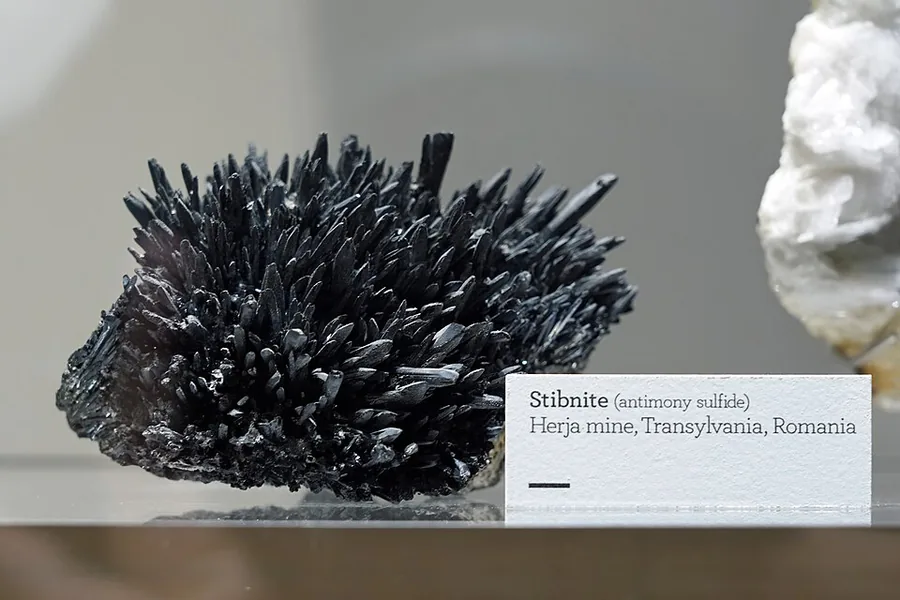
Antimony is a designated critical mineral, valued for the flame retardants, hardening alloys and emerging liquid-metal energy-storage chemistries that depend on it. It is won almost entirely as stibnite (antimony sulphide), and MineDSS models the two settings that host most of the world's primary supply: orogenic and epithermal antimony systems.
Read more: the deposit model, why it matters and where it is used +
More on antimony
In orogenic systems, antimony is concentrated by metamorphic fluids in deformed terranes and is closely bound up with gold; in epithermal systems it is deposited from shallow hydrothermal fluids in volcanic settings. Both leave a distinctive geochemical footprint, an arsenic-gold-mercury signature far wider than the ore itself, and that footprint is what a prospectivity model learns to read.
The deposit model
Orogenic antimony systems form where metamorphic fluids migrate through deformed, commonly greenstone or metasedimentary terranes and precipitate stibnite in quartz veins, shear zones and saddle reefs under strong structural control, often in the same fluid systems that carry orogenic gold. Epithermal systems form at shallow crustal levels in volcanic arcs, where cooling hydrothermal fluids deposit stibnite with silica, sulphides and clay alteration along faults and permeable horizons. Sericitic, silicic and argillic alteration mark the systems, and the arsenic-gold-mercury association is diagnostic.
Why it matters
Antimony sits on the critical-minerals lists of the major economies, and for good reason: it is difficult to substitute in flame retardants, it hardens the lead alloys used across industry and defence, and it is drawing fresh attention as a component of liquid-metal grid-storage chemistries. Global supply is geographically concentrated and exposed to processing and export bottlenecks, which keeps Western governments and manufacturers focused on securing diversified primary sources. That concern is sustaining exploration interest across established and frontier antimony provinces.
Where it's used
Antimony trioxide is the workhorse flame retardant that renders plastics, textiles and electronics fire-resistant. Antimony metal hardens the lead in lead-acid battery grids, bearings, cable sheathing and ammunition, and it is used in solders and specialty alloys. It also serves in glass and ceramics as a clarifying and opacifying agent, in pigments, and increasingly as an active component in emerging liquid-metal and grid-scale energy-storage systems.
Questions
Antimony: common questions.
Which antimony deposit types does MineDSS model? +
MineDSS models orogenic and epithermal antimony (stibnite) systems, the two settings that host most primary antimony supply. Orogenic systems are structurally controlled stibnite veins and shear-hosted mineralisation formed by metamorphic fluids in deformed terranes, closely associated with orogenic gold. Epithermal systems are shallow, volcanic-hosted stibnite deposited from hydrothermal fluids along faults and permeable horizons.
How is the model tested, and where can I run antimony? +
Every MineDSS model is tested before it is served: we withhold whole blocks of ground, rebuild the model without them, and check that it still ranks the anomalous samples there above background, with test ground kept spatially separate. A model that does not pass our release gates is not used, for any mineral, in any country. National models for antimony run in Australia, the United States and Canada, with ranked targets. Anywhere else in the world, the global model returns the prospectivity map, the geology behind it and a confidence read. Skill is model-level, never a specific site's measured accuracy, and never a discovery or JORC / NI 43-101 resource claim.
Why do gold, arsenic and mercury matter for antimony? +
Arsenic, gold and mercury form the diagnostic signature of stibnite systems, reflecting the shared fluids that carry antimony alongside gold in orogenic settings and through shallow epithermal systems. Silver, tungsten and lead complete the suite, tracking the broader hydrothermal footprint. These elements are part of the geochemical record our models learn from. In a run on any piece of ground, the map itself is read from geology and rock age, gravity and magnetics, radiometrics, terrain, satellite radar and spectral alteration, so it covers ground that has never been sampled.
Does a high MineDSS score mean there is a deposit? +
No. A high score means its evidence closely matches ground where samples assay anomalously high for antimony, so it ranks as more prospective and warrants further work. It is a prioritisation of where to look, not a discovery, not a JORC or NI 43-101 resource or reserve estimate, and not drilling or investment advice. Ground truth still requires field verification and drilling.
-
Partners
Exploration and mining companies interested in working with us.
-
Investors
The record, the models and the ground they point to.
-
Publishers and researchers
Geological surveys, universities and programmes whose work the record is built on.
MineDSS ranks prospectivity to help you decide where to explore next. It is not a discovery, not a JORC or NI 43-101 resource or reserve estimate, and not drilling or investment advice.