magmatic / laterite
Nickel & cobalt prospectivityacross Australia, the USA, Canada & worldwide for nickel.
Magmatic and lateritic nickel-cobalt, ranked and explained across Australia, the United States and Canada. Elsewhere, our global model maps nickel.
-
 ✓
✓ Australia
Ranked targets
-
 ✓
✓ United States
Ranked targets
-
 ✓
✓ Canada
Ranked targets
- ✓
Everywhere else
Global model · nickel
Ranked targets come with national models in Australia, the United States and Canada. Everywhere else, the global model returns the prospectivity map, the geology behind it and a confidence read. Next, the models are retrained on the full record and new sources, such as hyperspectral imagery, before we use them to rank and select ground.
How we rank nickel & cobalt ground
From a country to a decision.
- 01 · Atlas
Know the ground
The geology, structure, recorded deposits, tenure and geochemistry over the ground, on one map with the source of every layer.
See Atlas - 02 · Open Ground
Find ground you can peg
Which ground is open, held or excluded, read from each licensing authority's own register.
See Open Ground - 03 · Prospectivity
Rank it for nickel & cobalt
The ground scored for nickel & cobalt, with the evidence behind it and ranked targets in Australia, the United States and Canada. Anywhere else, the global model maps nickel.
See Prospectivity - 04 · Spectral
Map the alteration
The alteration minerals and the structures that control them, from satellite: regional to district scale, and camp scale from WorldView-3.
See Spectral - 05 · Due Diligence
Check before committing
Tenure, land access, environment and the real cost to hold and test a nickel & cobalt position.
See Due Diligence -
Talk to us about nickel & cobalt
Partners, investors, publishers and researchers.
Live examples
See nickel & cobalt on real ground.
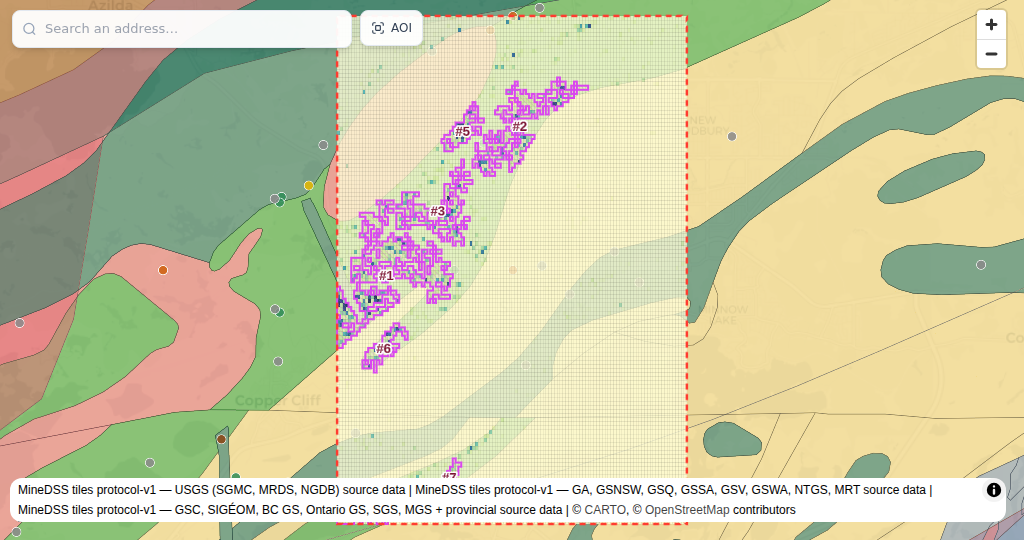
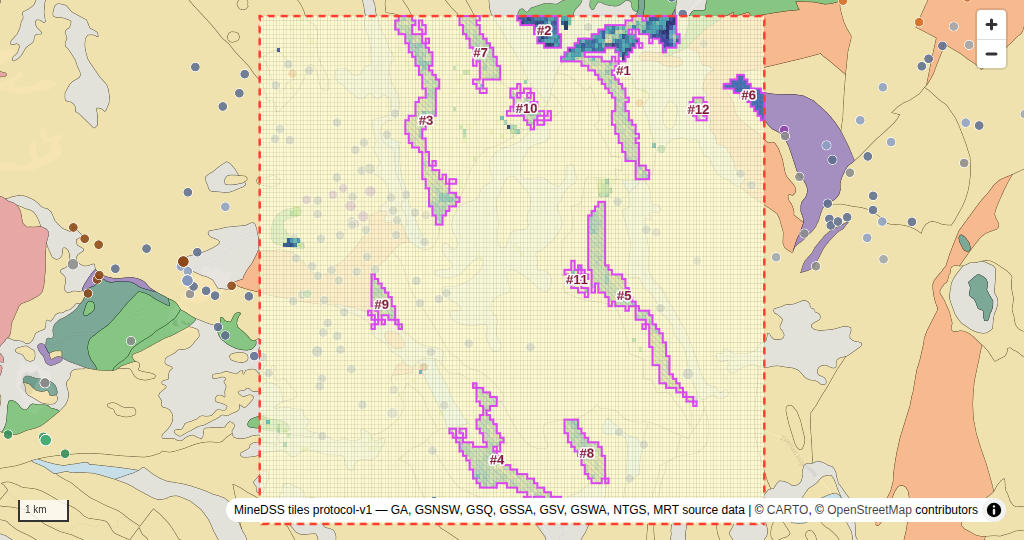
Example runs with the prospectivity map, the reasoning behind each target and the geology beneath it. No login needed.
The deposit system
The nickel & cobalt system.
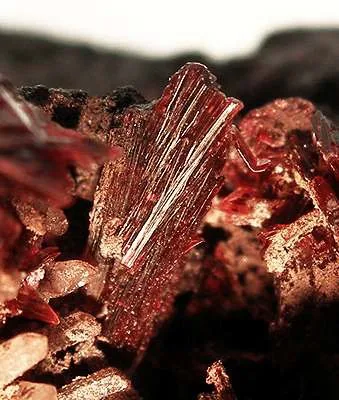
Nickel and cobalt are the workhorse metals of the energy transition, and they occur together in two very different geological settings that MineDSS models side by side. Magmatic sulphide systems form where mantle-derived mafic and ultramafic magmas become saturated in sulphur and drop dense immiscible sulphide liquid that concentrates nickel, cobalt and copper.
Read more: the deposit model, why it matters and where it is used +
More on nickel & cobalt
This is the classic style at intrusive and komatiitic centres. Lateritic systems form at the surface, where deep tropical weathering of ultramafic bedrock leaches and re-concentrates nickel and cobalt into thick, layered regolith profiles. The two systems share a source-rock chemistry but leave entirely different footprints, and a prospectivity model has to read both.
The deposit model
Magmatic sulphide deposits sit within and beneath mafic-ultramafic intrusions and komatiite flows, controlled by magma pathways, feeder conduits and structural traps where sulphide liquid could pond. They carry a distinctive nickel-copper-cobalt sulphide assemblage (pyrrhotite, pentlandite and chalcopyrite) and a dense, often magnetic signature. Lateritic nickel-cobalt sits above ultramafic parent rock, its grade and thickness governed by weathering intensity, drainage and the preserved regolith profile, so terrain, landscape stability and surface expression matter as much as bedrock.
Why it matters
Nickel and cobalt sit at the centre of electrification. Nickel underpins stainless steel and high-nickel battery chemistries, while cobalt stabilises those same cathodes and remains critical to high-performance alloys. Both are designated critical or strategic minerals across Australia, the USA and Canada, which keeps exploration, supply security and domestic processing high on government and industry agendas. As grid-scale storage and electrified transport build out, the search for new nickel-cobalt sources (and for secure, well-characterised ground to explore) stays structurally supported through the commodity cycle.
Where it's used
Nickel's corrosion resistance and strength make it indispensable in stainless steel, superalloys for jet engines and gas turbines, plating and specialist chemicals. Cobalt is essential to lithium-ion battery cathodes, to the superalloys and cutting-tool carbides that operate at extreme temperature, and to permanent magnets and catalysts. Together they anchor the materials base for aerospace, defence, grid storage and electrified transport, which is why both are treated as strategic supply-chain metals.
Questions
Nickel & cobalt: common questions.
Which nickel and cobalt deposit types does MineDSS model? +
Two systems that hold most of the world's nickel and cobalt: magmatic sulphide deposits, where mantle-derived mafic-ultramafic magmas concentrate nickel, cobalt and copper into sulphide, and lateritic nickel-cobalt, where deep tropical weathering of ultramafic bedrock re-concentrates both metals into thick regolith. Nickel-cobalt terrains such as Sudbury in Ontario and Avebury in Tasmania sit within or adjacent to these settings. The model is tuned to these two systems, not to every nickel occurrence.
How is the model tested, and where can I run nickel & cobalt? +
Every MineDSS model is tested before it is served: we withhold whole blocks of ground, rebuild the model without them, and check that it still ranks the anomalous samples there above background, with test ground kept spatially separate. A model that does not pass our release gates is not used, for any mineral, in any country. National models for nickel & cobalt run in Australia, the United States and Canada, with ranked targets. Anywhere else in the world, the global model maps nickel on its own and returns the prospectivity map, the geology behind it and a confidence read. Skill is model-level, never a specific site's measured accuracy, and never a discovery or JORC / NI 43-101 resource claim.
Why do pathfinder elements matter for nickel and cobalt? +
A mineralising system leaves a chemical footprint far wider than the ore itself. Chromium, cobalt and sulphur trace the ultramafic source rocks and their sulphide budget that both systems share, while lead, zinc, arsenic and gold help characterise associated mineralisation. These elements are part of the geochemical record our models learn from. In a run on any piece of ground, the map itself is read from geology and rock age, gravity and magnetics, radiometrics, terrain, satellite radar and spectral alteration, so it covers ground that has never been sampled.
Does a high MineDSS score mean there is a deposit? +
No. A high score means its evidence closely matches ground where samples assay anomalously high for nickel and cobalt, and it is worth prioritising for further work. It is a prospectivity ranking to focus exploration, not a discovery, not a JORC or NI 43-101 resource or reserve estimate, and not drilling or investment advice.
-
Partners
Exploration and mining companies interested in working with us.
-
Investors
The record, the models and the ground they point to.
-
Publishers and researchers
Geological surveys, universities and programmes whose work the record is built on.
MineDSS ranks prospectivity to help you decide where to explore next. It is not a discovery, not a JORC or NI 43-101 resource or reserve estimate, and not drilling or investment advice.