carbonatite / alkaline
Lanthanum prospectivityacross Australia, the USA & worldwide.
Carbonatite and alkaline igneous lanthanum, ranked and explained across the United States and Australia.
-
 ✓
✓ Australia
Ranked targets
-
 ✓
✓ United States
Ranked targets
-
 ·
· Canada
Not modelled
- ✓
Everywhere else
Global model
Ranked targets come with national models in Australia and the United States. Everywhere else, the global model returns the prospectivity map, the geology behind it and a confidence read. Next, the models are retrained on the full record and new sources, such as hyperspectral imagery, before we use them to rank and select ground.
How we rank lanthanum ground
From a country to a decision.
- 01 · Atlas
Know the ground
The geology, structure, recorded deposits, tenure and geochemistry over the ground, on one map with the source of every layer.
See Atlas - 02 · Open Ground
Find ground you can peg
Which ground is open, held or excluded, read from each licensing authority's own register.
See Open Ground - 03 · Prospectivity
Rank it for lanthanum
The ground scored for lanthanum, with the evidence behind it and ranked targets in Australia and the United States. Anywhere else, the global model maps lanthanum.
See Prospectivity - 04 · Spectral
Map the alteration
The alteration minerals and the structures that control them, from satellite: regional to district scale, and camp scale from WorldView-3.
See Spectral - 05 · Due Diligence
Check before committing
Tenure, land access, environment and the real cost to hold and test a lanthanum position.
See Due Diligence -
Talk to us about lanthanum
Partners, investors, publishers and researchers.
The deposit system
The lanthanum system.
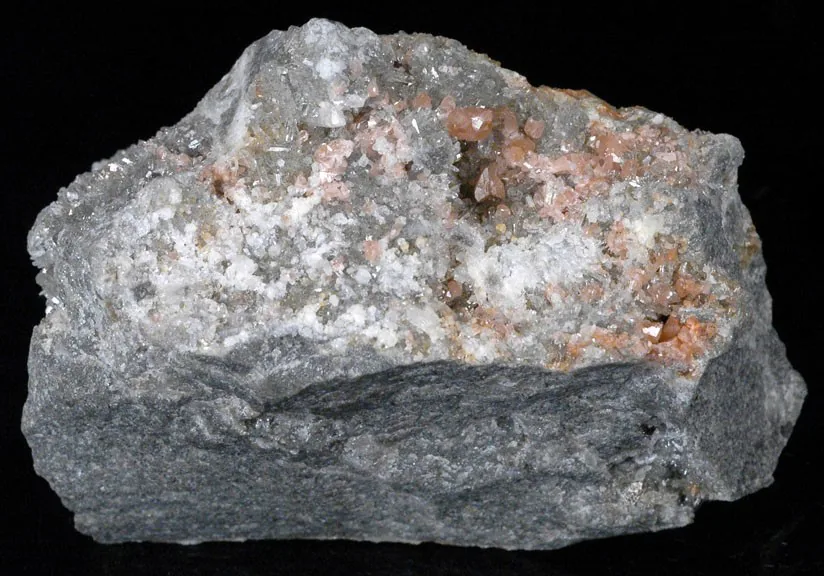
Lanthanum is a soft, silvery light rare-earth element, the first of the lanthanide series and one of the more abundant rare earths in the crust. It is seldom concentrated on its own; instead it is won from the light-rare-earth suite alongside cerium, praseodymium and neodymium.
Read more: the deposit model, why it matters and where it is used +
More on lanthanum
Its principal ore minerals are the fluorocarbonate bastnäsite and the phosphate monazite, with parisite, synchysite, ancylite and allanite as further hosts. Economic concentrations form in carbonatite and alkaline igneous systems, where mantle-derived, carbonate- and alkali-rich magmas concentrate the rare earths and where later weathering can upgrade them further. These systems leave a mappable footprint: distinctive intrusive and metasomatic rocks, a radiometric signature and a characteristic incompatible-element geochemical halo. That is exactly the pattern a prospectivity model is built to read across large, partly covered terrains.
The deposit model
Carbonatite systems form from mantle-derived, carbonate-rich magmas that ascend along deep structures and emplace as plugs, dykes, veins and stockworks; bastnäsite, monazite and related minerals crystallise as the melt evolves, while alkali-rich fluids drive fenitisation (sodic and potassic metasomatism) of the surrounding wall rocks. Alkaline and peralkaline igneous complexes concentrate the same light-rare-earth suite in silica-undersaturated, often zoned intrusions, sometimes associated with diatreme breccias, where incompatible elements are enriched in accessory phases. In both settings, later weathering can strip away carbonate and gangue to upgrade residual and supergene ore.
Why it matters
Lanthanum is classified within the rare earths as a critical or strategic mineral across the United States and other major economies, because the light-rare-earth suite underpins petroleum refining, energy storage and precision optics. Although lanthanum is geologically among the more abundant rare earths, its supply is constrained less by geology than by the concentration of mining and, above all, separation and processing capacity in a small number of countries. That imbalance has prompted policy action to build secure, diversified domestic sources of rare-earth raw materials. Because carbonatite and alkaline systems are relatively few and the path from discovery to production is long, transparent, defensible targeting of prospective ground carries real strategic weight for explorers and the governments that permit them.
Where it's used
The largest single use of lanthanum is in fluid catalytic cracking catalysts, where lanthanum-stabilised zeolites help refineries convert heavy crude oil into petrol, diesel and other lighter fuels. It is a key component of the mischmetal and hydrogen-storage alloys used in nickel-metal-hydride batteries for hybrid vehicles and portable power. Lanthanum oxide gives optical glass a high refractive index and low dispersion, making it central to camera lenses and precision optics. Further uses span phosphors, ceramics, speciality catalysts, carbon-arc lighting and, as lanthanum carbonate, medical phosphate binders. These applications make secure, well-characterised supply a matter of both industrial and national interest.
Questions
Lanthanum: common questions.
Which lanthanum deposit types does MineDSS model? +
MineDSS models lanthanum and the light-rare-earth suite in two settings: carbonatite systems and alkaline igneous systems. Carbonatite deposits host bastnäsite, monazite and related fluorocarbonate and phosphate minerals in mantle-derived, carbonate-rich intrusions, veins and stockworks, often with fenitised wall rocks. Alkaline and peralkaline complexes concentrate the same rare-earth suite in silica-undersaturated intrusions, sometimes upgraded by later weathering. The model ranks ground by how closely its evidence matches ground where samples assay anomalously high for the target mineral, and does not attempt to represent unrelated rare-earth styles such as ion-adsorption clays or placer monazite.
How is the model tested, and where can I run lanthanum? +
Every MineDSS model is tested before it is served: we withhold whole blocks of ground, rebuild the model without them, and check that it still ranks the anomalous samples there above background, with test ground kept spatially separate. A model that does not pass our release gates is not used, for any mineral, in any country. National models for lanthanum run in Australia and the United States, with ranked targets. Anywhere else in the world, the global model returns the prospectivity map, the geology behind it and a confidence read. Skill is model-level, never a specific site's measured accuracy, and never a discovery or JORC / NI 43-101 resource claim.
Which pathfinder elements track lanthanum? +
The classic pathfinders are thorium, uranium, zirconium, niobium, hafnium, tantalum and beryllium, with thorium, uranium and zirconium leading. These elements trace the radiometric response and incompatible-element enrichment that characterise carbonatite and alkaline systems: thorium and uranium ride within rare-earth minerals such as monazite, while the high-field-strength elements track the evolved, alkali-rich magmas that concentrate the light rare earths. These elements are part of the geochemical record our models learn from. In a run on any piece of ground, the map itself is read from geology and rock age, gravity and magnetics, radiometrics, terrain, satellite radar and spectral alteration, so it covers ground that has never been sampled.
Does a high MineDSS score mean a lanthanum deposit or a resource estimate? +
No. A high score means its evidence closely matches ground where samples assay anomalously high for the target mineral, and it merits closer exploration attention. It is not a discovery, not a JORC or NI 43-101 resource or reserve estimate, and not drilling or investment advice. MineDSS ranks prospectivity to help prioritise where to look; confirming whether lanthanum is present, and at what grade and tonnage, still requires field programmes, drilling and independent assessment by qualified professionals.
-
Partners
Exploration and mining companies interested in working with us.
-
Investors
The record, the models and the ground they point to.
-
Publishers and researchers
Geological surveys, universities and programmes whose work the record is built on.
MineDSS ranks prospectivity to help you decide where to explore next. It is not a discovery, not a JORC or NI 43-101 resource or reserve estimate, and not drilling or investment advice.