alkaline / ion-adsorption
Dysprosium prospectivityacross Australia, the USA & worldwide.
Alkaline igneous and ion-adsorption dysprosium, ranked and explained across the United States and Australia.
-
 ✓
✓ Australia
Ranked targets
-
 ✓
✓ United States
Ranked targets
-
 ·
· Canada
Not modelled
- ✓
Everywhere else
Global model
Ranked targets come with national models in Australia and the United States. Everywhere else, the global model returns the prospectivity map, the geology behind it and a confidence read. Next, the models are retrained on the full record and new sources, such as hyperspectral imagery, before we use them to rank and select ground.
How we rank dysprosium ground
From a country to a decision.
- 01 · Atlas
Know the ground
The geology, structure, recorded deposits, tenure and geochemistry over the ground, on one map with the source of every layer.
See Atlas - 02 · Open Ground
Find ground you can peg
Which ground is open, held or excluded, read from each licensing authority's own register.
See Open Ground - 03 · Prospectivity
Rank it for dysprosium
The ground scored for dysprosium, with the evidence behind it and ranked targets in Australia and the United States. Anywhere else, the global model maps dysprosium.
See Prospectivity - 04 · Spectral
Map the alteration
The alteration minerals and the structures that control them, from satellite: regional to district scale, and camp scale from WorldView-3.
See Spectral - 05 · Due Diligence
Check before committing
Tenure, land access, environment and the real cost to hold and test a dysprosium position.
See Due Diligence -
Talk to us about dysprosium
Partners, investors, publishers and researchers.
The deposit system
The dysprosium system.
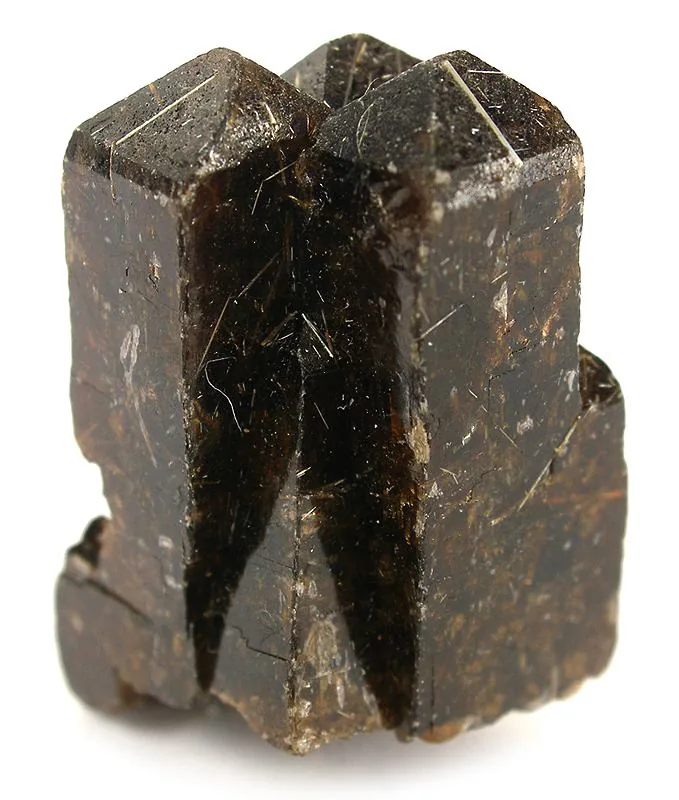
Dysprosium is a heavy rare-earth element, a soft, silvery lanthanide prized less for the metal itself than for the properties it lends to permanent magnets. It rarely forms minerals of its own; instead it substitutes into rare-earth and yttrium phases such as xenotime, zircon, fergusonite and eudialyte, and in deeply weathered terrains it is held as loosely bound ions on clay surfaces.
Read more: the deposit model, why it matters and where it is used +
More on dysprosium
MineDSS models dysprosium through two systems: alkaline igneous and ion-adsorption. Both concentrate the heavy rare earths from the same starting ingredient (a magma unusually rich in incompatible elements), and both leave a mappable footprint of distinctive geology, radiometric response and multi-element geochemistry that a prospectivity model is built to read across large, partly covered terrains.
The deposit model
Alkaline igneous systems begin with peralkaline granites, syenites, rhyolites and their pegmatites, crystallised from magmas so enriched in incompatible high-field-strength elements that the heavy rare earths, along with zirconium, niobium, thorium and uranium, are driven into late fluorine-rich melts and fluids. There they are fixed in minerals such as xenotime, zircon, fergusonite, eudialyte and yttrofluorite, disseminated through the intrusion or concentrated along its margins. Ion-adsorption systems are the weathered expression of the same chemistry: prolonged subtropical weathering of a rare-earth-enriched granite breaks down its primary minerals and releases the rare earths, which are adsorbed as easily leachable ions onto kaolinite in the residual clay profile, with the heavy rare earths preferentially retained.
Why it matters
Dysprosium is classified as a critical and strategic mineral, and among the rare earths it sits with the highest supply-risk elements on national critical-minerals lists. Its importance is disproportionate to the tiny quantities used: adding a few per cent of dysprosium to a neodymium-iron-boron magnet sharply raises its coercivity, the resistance to demagnetisation that lets the magnet keep working at the elevated temperatures inside electric-vehicle traction motors and direct-drive wind-turbine generators. Because production and processing are geographically concentrated and subject to export controls, and because there is no ready substitute in high-temperature magnets, transparent and defensible targeting of prospective ground carries real strategic weight for explorers and for the governments that permit them.
Where it's used
By far the largest use of dysprosium is in high-performance neodymium-iron-boron permanent magnets, where it preserves magnetic strength at temperature and so underpins electric-vehicle drivetrains, wind-turbine generators, robotics and aerospace actuators. Its exceptional ability to absorb thermal neutrons makes dysprosium and dysprosium-titanate valuable in nuclear-reactor control rods. It is also a component of magnetostrictive alloys used in sonar transducers and precision actuators, of dosimetry phosphors that measure ionising radiation, and of specialty ceramics, lasers and infrared optics. Across these applications the common thread is that small additions of dysprosium deliver performance that is difficult to achieve any other way.
Questions
Dysprosium: common questions.
Which dysprosium deposit types does MineDSS model? +
MineDSS models two systems: alkaline igneous and ion-adsorption heavy-rare-earth systems. Alkaline igneous systems host dysprosium in peralkaline granites, syenites, rhyolites and pegmatites, where the heavy rare earths are locked into minerals such as xenotime, zircon, fergusonite and yttrofluorite. Ion-adsorption systems are the deeply weathered expression of the same enriched rocks, where rare earths are held as easily leachable ions on kaolinite clay in the regolith. Both concentrate the heavy rare earths from a magma rich in incompatible elements, and it is that shared footprint the model is built to read rather than unrelated deposit styles.
How is the model tested, and where can I run dysprosium? +
Every MineDSS model is tested before it is served: we withhold whole blocks of ground, rebuild the model without them, and check that it still ranks the anomalous samples there above background, with test ground kept spatially separate. A model that does not pass our release gates is not used, for any mineral, in any country. National models for dysprosium run in Australia and the United States, with ranked targets. Anywhere else in the world, the global model returns the prospectivity map, the geology behind it and a confidence read. Skill is model-level, never a specific site's measured accuracy, and never a discovery or JORC / NI 43-101 resource claim.
Which pathfinder elements track dysprosium? +
The classic pathfinders are zirconium, niobium, thorium, uranium, hafnium, tantalum and beryllium, with zirconium, niobium and thorium leading. These high-field-strength elements concentrate in the same peralkaline melts and fluids as the heavy rare earths and survive into the weathered clay profile, so they trace the settings where dysprosium enrichment is most likely. These elements are part of the geochemical record our models learn from. In a run on any piece of ground, the map itself is read from geology and rock age, gravity and magnetics, radiometrics, terrain, satellite radar and spectral alteration, so it covers ground that has never been sampled.
Does a high MineDSS score mean a deposit or a resource estimate? +
No. A high score means its evidence closely matches ground where samples assay anomalously high for the target mineral, and it merits closer exploration attention. It is not a discovery, not a JORC or NI 43-101 resource or reserve estimate, and not drilling or investment advice. MineDSS ranks prospectivity to help prioritise where to look; confirming whether dysprosium is present, and in what grade and quantity, still requires field programmes, drilling and independent assessment by qualified professionals.
-
Partners
Exploration and mining companies interested in working with us.
-
Investors
The record, the models and the ground they point to.
-
Publishers and researchers
Geological surveys, universities and programmes whose work the record is built on.
MineDSS ranks prospectivity to help you decide where to explore next. It is not a discovery, not a JORC or NI 43-101 resource or reserve estimate, and not drilling or investment advice.