sedimentary / carbonatite
Strontium prospectivityacross Australia, the USA, Canada & worldwide.
Sedimentary-hosted and carbonatite-related strontium, ranked and explained across Australia, the United States and Canada.
-
 ✓
✓ Australia
Ranked targets
-
 ✓
✓ United States
Ranked targets
-
 ✓
✓ Canada
Ranked targets
- ✓
Everywhere else
Global model
Ranked targets come with national models in Australia, the United States and Canada. Everywhere else, the global model returns the prospectivity map, the geology behind it and a confidence read. Next, the models are retrained on the full record and new sources, such as hyperspectral imagery, before we use them to rank and select ground.
How we rank strontium ground
From a country to a decision.
- 01 · Atlas
Know the ground
The geology, structure, recorded deposits, tenure and geochemistry over the ground, on one map with the source of every layer.
See Atlas - 02 · Open Ground
Find ground you can peg
Which ground is open, held or excluded, read from each licensing authority's own register.
See Open Ground - 03 · Prospectivity
Rank it for strontium
The ground scored for strontium, with the evidence behind it and ranked targets in Australia, the United States and Canada. Anywhere else, the global model maps strontium.
See Prospectivity - 04 · Spectral
Map the alteration
The alteration minerals and the structures that control them, from satellite: regional to district scale, and camp scale from WorldView-3.
See Spectral - 05 · Due Diligence
Check before committing
Tenure, land access, environment and the real cost to hold and test a strontium position.
See Due Diligence -
Talk to us about strontium
Partners, investors, publishers and researchers.
The deposit system
The strontium system.
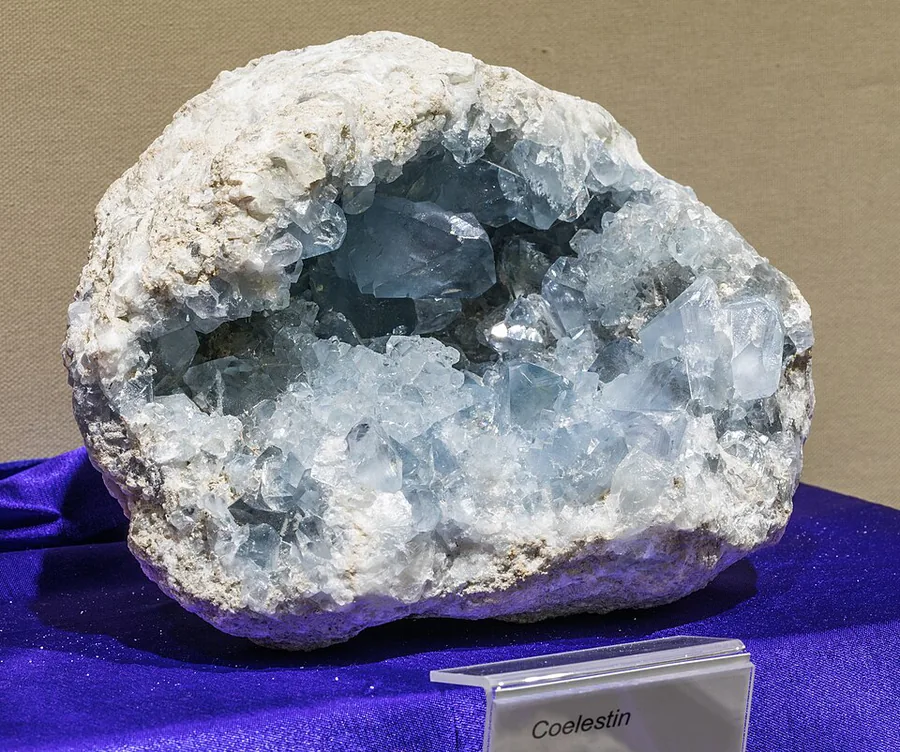
Strontium is a soft, highly reactive alkaline-earth metal that never occurs free in nature. Its economic concentrations are carried almost entirely by two minerals: celestine, a strontium sulphate, and strontianite, a strontium carbonate.
Read more: the deposit model, why it matters and where it is used +
More on strontium
MineDSS models strontium through two families. Sedimentary systems host celestine in carbonate-evaporite sequences, where strontium expelled from limestone and dolomite during burial meets sulphate-rich brines and precipitates in restricted, evaporitic basins. Carbonatite-related systems concentrate strontium in mantle-derived carbonate intrusions and their alkaline aureoles, alongside the rare earths, niobium and barium that share its geochemistry. Both leave a mappable footprint: distinctive host lithologies, characteristic geophysical responses and a co-located multi-element geochemical halo. That is precisely the pattern a prospectivity model is built to read across large, partly covered terrains.
The deposit model
The two systems form by very different pathways. Sedimentary celestine is diagenetic: as buried aragonite and high-strontium carbonate recrystallise to calcite and dolomite, strontium is expelled into pore fluids and fixed as celestine where it meets sulphate, typically in sabkha and restricted-basin evaporites interbedded with gypsum, anhydrite, halite and dolomitic limestone. Carbonatite-related strontium is magmatic and metasomatic: mantle-sourced carbonate melts and the alkaline fluids that follow them carry large-ion elements, so strontium substitutes for calcium in calcite and apatite and crystallises as strontianite, commonly with secondary barium-, strontium- and rare-earth-bearing carbonates.
Why it matters
Strontium is recognised as a critical raw material in the European Union, and its supply profile draws the same strategic scrutiny in other major economies, because demand for it is met almost entirely by imports from a small group of producers. No strontium mineral has been mined in the United States for decades, and domestic production of strontium chemicals ceased in the mid-2000s, leaving the country reliant on imported celestine and strontium compounds, while global primary supply and refining capacity remain concentrated in only a handful of countries. That combination of essential industrial uses and concentrated, import-exposed supply is exactly what draws strontium into critical- and strategic-minerals assessments, and it makes transparent, defensible targeting of prospective ground valuable to both explorers and the governments that permit them.
Where it's used
Strontium's largest markets are permanent ceramic ferrite magnets and pyrotechnics. Strontium carbonate is sintered with iron oxide to make the low-cost, corrosion-resistant ferrite magnets used in motors, loudspeakers and small electronics, while strontium salts give fireworks, signal flares and tracer rounds their characteristic brilliant crimson, a colour no other element reproduces as cleanly. Strontium sulphate serves as a weighting agent in drilling fluids, and strontium is added to aluminium casting alloys to refine their microstructure as well as to specialty glass and electronics. Smaller but high-value uses include medical applications, from compounds that treat bone conditions to formulations for sensitive teeth.
Questions
Strontium: common questions.
Which strontium deposit types does MineDSS model? +
MineDSS models two deposit systems: sedimentary-hosted and carbonatite-related strontium. Sedimentary systems host celestine, a strontium sulphate, in carbonate-evaporite sequences, where strontium expelled from limestone and dolomite during burial precipitates in restricted, sabkha-type evaporitic basins alongside gypsum, anhydrite and halite. Carbonatite-related systems concentrate strontium as strontianite and within calcite and apatite in mantle-derived carbonate intrusions and their alkaline aureoles, together with rare earths, niobium and barium. The model does not attempt to represent unrelated deposit styles; it ranks ground by how closely its evidence matches ground where samples assay anomalously high for the target mineral.
How is the model tested, and where can I run strontium? +
Every MineDSS model is tested before it is served: we withhold whole blocks of ground, rebuild the model without them, and check that it still ranks the anomalous samples there above background, with test ground kept spatially separate. A model that does not pass our release gates is not used, for any mineral, in any country. National models for strontium run in Australia, the United States and Canada, with ranked targets. Anywhere else in the world, the global model returns the prospectivity map, the geology behind it and a confidence read. Skill is model-level, never a specific site's measured accuracy, and never a discovery or JORC / NI 43-101 resource claim.
Which pathfinder elements track strontium? +
The classic pathfinders are barium, cerium, lanthanum, niobium, thorium and yttrium, led by barium and the light rare earths cerium and lanthanum. Barium follows strontium through both modelled families: the two form a sulphate solid solution in evaporites and co-enrich in carbonatites. Cerium, lanthanum, niobium, thorium and yttrium trace the rare-earth and high-field-strength chemistry that is diagnostic of carbonatite and alkaline systems. These elements are part of the geochemical record our models learn from. In a run on any piece of ground, the map itself is read from geology and rock age, gravity and magnetics, radiometrics, terrain, satellite radar and spectral alteration, so it covers ground that has never been sampled.
Does a high MineDSS score mean a deposit or a resource estimate? +
No. A high score means its evidence closely matches ground where samples assay anomalously high for the target mineral, and it merits closer exploration attention. It is not a discovery, not a JORC or NI 43-101 resource estimate, and not drilling or investment advice. MineDSS ranks prospectivity to help prioritise where to look; confirming whether economic celestine or strontianite is present, and in what quantity and grade, still requires field programmes, drilling and independent assessment by qualified professionals.
-
Partners
Exploration and mining companies interested in working with us.
-
Investors
The record, the models and the ground they point to.
-
Publishers and researchers
Geological surveys, universities and programmes whose work the record is built on.
MineDSS ranks prospectivity to help you decide where to explore next. It is not a discovery, not a JORC or NI 43-101 resource or reserve estimate, and not drilling or investment advice.