alkaline complex / placer
Zirconium prospectivityacross Australia, the USA, Canada & worldwide.
Zirconium in alkaline igneous complexes and heavy-mineral placers, ranked and explained across Australia, the United States and Canada.
-
 ✓
✓ Australia
Ranked targets
-
 ✓
✓ United States
Ranked targets
-
 ✓
✓ Canada
Ranked targets
- ✓
Everywhere else
Global model
Ranked targets come with national models in Australia, the United States and Canada. Everywhere else, the global model returns the prospectivity map, the geology behind it and a confidence read. Next, the models are retrained on the full record and new sources, such as hyperspectral imagery, before we use them to rank and select ground.
How we rank zirconium ground
From a country to a decision.
- 01 · Atlas
Know the ground
The geology, structure, recorded deposits, tenure and geochemistry over the ground, on one map with the source of every layer.
See Atlas - 02 · Open Ground
Find ground you can peg
Which ground is open, held or excluded, read from each licensing authority's own register.
See Open Ground - 03 · Prospectivity
Rank it for zirconium
The ground scored for zirconium, with the evidence behind it and ranked targets in Australia, the United States and Canada. Anywhere else, the global model maps zirconium.
See Prospectivity - 04 · Spectral
Map the alteration
The alteration minerals and the structures that control them, from satellite: regional to district scale, and camp scale from WorldView-3.
See Spectral - 05 · Due Diligence
Check before committing
Tenure, land access, environment and the real cost to hold and test a zirconium position.
See Due Diligence -
Talk to us about zirconium
Partners, investors, publishers and researchers.
The deposit system
The zirconium system.
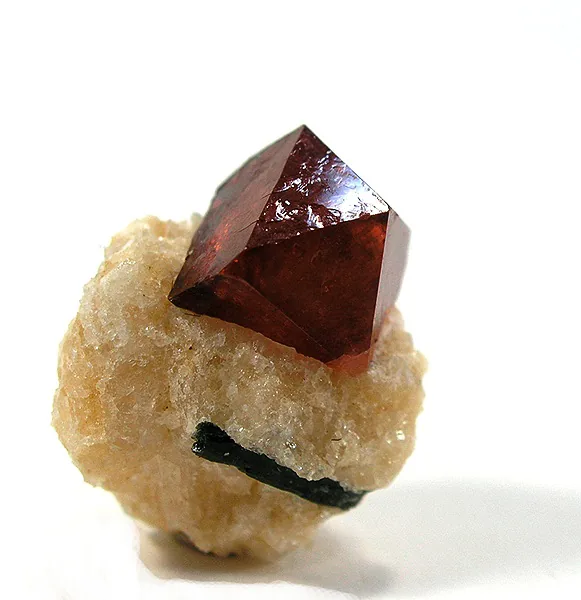
Zirconium is a strong, corrosion- and heat-resistant transition metal whose economic concentrations are carried almost entirely by zircon, a dense zirconium silicate so chemically durable that it both crystallises in igneous rocks and survives weathering to accumulate in sedimentary sands; zircon is also the world's sole commercial source of hafnium. Lesser hosts include baddeleyite, a zirconium oxide, and the sodium-zirconium silicate eudialyte found in alkaline rocks.
Read more: the deposit model, why it matters and where it is used +
More on zirconium
MineDSS models zirconium through two deposit systems: alkaline igneous complexes and heavy-mineral placers. Each leaves a mappable footprint (highly fractionated alkaline intrusions and their alteration, or dense heavy-mineral concentrations in coastal and fluvial sands) together with a distinctive high-field-strength geochemical halo that a prospectivity model is built to read across large, partly covered terrains.
The deposit model
Alkaline igneous complexes concentrate zirconium through extreme fractional crystallisation of alkaline to peralkaline magmas. As these melts evolve, zirconium and the other incompatible high-field-strength elements are excluded from early-crystallising minerals and enriched in the residual magma, ultimately forming zircon, eudialyte and related phases in peralkaline granites and agpaitic nepheline syenites; late fluoride-rich melts and hydrothermal fluids can sharpen the enrichment, and carbonatites carry baddeleyite by a related route. Heavy-mineral placers form when weathering liberates durable zircon grains from such source rocks and rivers, waves and wind hydraulically sort the dense, resistant grains into beach, dune and fluvial concentrations alongside ilmenite, rutile and monazite.
Why it matters
Zirconium is a strategic industrial material and appears on the United States critical-minerals lists, reflecting its role in both nuclear energy and high-performance manufacturing. Its combination of very low neutron absorption, corrosion resistance and high-temperature strength makes it difficult to substitute in reactor and chemical-plant service, while zircon underpins refractories, foundries and advanced ceramics. Commercial mine supply is concentrated in a handful of countries and comes largely as a co-product of titanium-mineral sands, so its availability is partly tied to other markets. Zircon is also the sole feedstock for hafnium, a further critical metal. Transparent, defensible identification of prospective ground therefore carries real weight for both enterprise and government stakeholders.
Where it's used
The largest end uses of zircon are refractories, foundry and investment-casting sands, and ceramic opacifiers and glazes, where its hardness, high melting point and chemical inertness are prized. Refined to zirconium metal and its alloys, it clads nuclear fuel and lines pipes, valves and heat exchangers in aggressive chemical service. Zirconia, the zirconium oxide, is a technical ceramic used in dental restorations, thermal-barrier coatings, oxygen sensors, cutting tools and fibre-optic components. Hafnium, separated during zirconium refining, serves nuclear control rods and nickel-based superalloys. Together these applications make secure, well-characterised supply a matter of both industrial and national interest.
Questions
Zirconium: common questions.
Which zirconium deposit types does MineDSS model? +
MineDSS models two systems: alkaline igneous complexes and heavy-mineral placers. Alkaline complexes concentrate zirconium through extreme fractionation of alkaline to peralkaline magmas, forming zircon, eudialyte and baddeleyite in peralkaline granites, agpaitic nepheline syenites and related carbonatites. Heavy-mineral placers form where weathering frees durable zircon grains and rivers, waves and wind sort them into beach, dune and fluvial concentrations alongside ilmenite, rutile and monazite. Both leave a distinct footprint (a fractionated igneous system or a sorted heavy-mineral concentration with its high-field-strength geochemical halo), which is what the model is built to read.
How is the model tested, and where can I run zirconium? +
Every MineDSS model is tested before it is served: we withhold whole blocks of ground, rebuild the model without them, and check that it still ranks the anomalous samples there above background, with test ground kept spatially separate. A model that does not pass our release gates is not used, for any mineral, in any country. National models for zirconium run in Australia, the United States and Canada, with ranked targets. Anywhere else in the world, the global model returns the prospectivity map, the geology behind it and a confidence read. Skill is model-level, never a specific site's measured accuracy, and never a discovery or JORC / NI 43-101 resource claim.
Which pathfinder elements track zirconium? +
The classic pathfinders are niobium, tantalum, yttrium, thorium, uranium and beryllium, with niobium, tantalum and yttrium leading. These are the co-located high-field-strength and granophile elements that concentrate with zirconium: in alkaline complexes they are enriched together in highly evolved peralkaline melts, and in placers they travel with zircon and companion heavy minerals such as monazite and xenotime. Thorium and uranium also lend a radiometric expression that helps map fertile ground. These elements are part of the geochemical record our models learn from. In a run on any piece of ground, the map itself is read from geology and rock age, gravity and magnetics, radiometrics, terrain, satellite radar and spectral alteration, so it covers ground that has never been sampled.
Does a high MineDSS score mean a zirconium deposit or a resource estimate? +
No. A high score means its evidence closely matches ground where samples assay anomalously high for the target mineral, and it merits closer exploration attention. It is not a discovery, not a JORC or NI 43-101 resource or reserve estimate, and not drilling or investment advice. MineDSS ranks prospectivity to help prioritise where to look; confirming whether economic zirconium mineralisation is present, and in what quantity and grade, still requires field programmes, sampling, drilling and independent assessment by qualified professionals.
-
Partners
Exploration and mining companies interested in working with us.
-
Investors
The record, the models and the ground they point to.
-
Publishers and researchers
Geological surveys, universities and programmes whose work the record is built on.
MineDSS ranks prospectivity to help you decide where to explore next. It is not a discovery, not a JORC or NI 43-101 resource or reserve estimate, and not drilling or investment advice.