zinc-sulphide / tin-polymetallic
Indium prospectivityacross Australia, the USA & worldwide.
Indium enrichment in zinc-sulphide and tin-polymetallic systems, ranked and explained across the United States and Australia.
-
 ✓
✓ Australia
Ranked targets
-
 ✓
✓ United States
Ranked targets
-
 ·
· Canada
Not modelled
- ✓
Everywhere else
Global model
Ranked targets come with national models in Australia and the United States. Everywhere else, the global model returns the prospectivity map, the geology behind it and a confidence read. Next, the models are retrained on the full record and new sources, such as hyperspectral imagery, before we use them to rank and select ground.
How we rank indium ground
From a country to a decision.
- 01 · Atlas
Know the ground
The geology, structure, recorded deposits, tenure and geochemistry over the ground, on one map with the source of every layer.
See Atlas - 02 · Open Ground
Find ground you can peg
Which ground is open, held or excluded, read from each licensing authority's own register.
See Open Ground - 03 · Prospectivity
Rank it for indium
The ground scored for indium, with the evidence behind it and ranked targets in Australia and the United States. Anywhere else, the global model maps indium.
See Prospectivity - 04 · Spectral
Map the alteration
The alteration minerals and the structures that control them, from satellite: regional to district scale, and camp scale from WorldView-3.
See Spectral - 05 · Due Diligence
Check before committing
Tenure, land access, environment and the real cost to hold and test a indium position.
See Due Diligence -
Talk to us about indium
Partners, investors, publishers and researchers.
The deposit system
The indium system.
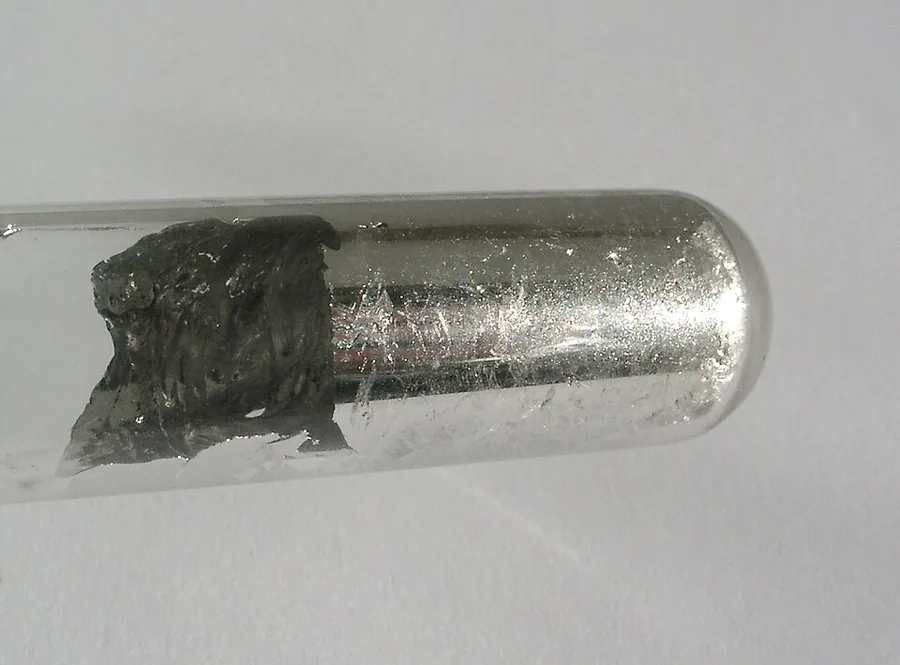
Indium is a soft, silvery post-transition metal so scarce and finely dispersed that it forms no ore of its own. It is won almost entirely as a by-product, recovered from the zinc-sulphide mineral sphalerite during zinc smelting, where indium substitutes into the crystal lattice at concentrations ranging from a fraction of a part per million to around a hundred.
Read more: the deposit model, why it matters and where it is used +
More on indium
Its best-known discrete mineral, roquesite, a copper-indium sulphide, occurs only in trace amounts and is never economic on its own. MineDSS models indium through the two host families that carry most of the world's resources: zinc-sulphide systems and tin-polymetallic systems. Both leave a mappable footprint of sulphide mineralisation, hydrothermal alteration and a distinctive multi-element geochemical halo, which is exactly the pattern a prospectivity model is built to read across large, partly covered terrains.
The deposit model
Indium is a passenger metal: it concentrates wherever sulphide chemistry favours its entry into sphalerite and associated minerals, so the model targets the settings that host it rather than an indium ore body. Zinc-sulphide systems (volcanogenic massive sulphide, sediment-hosted zinc-lead, skarn and polymetallic epithermal deposits) carry indium within sphalerite, and its tenor rises where zinc and copper run high together. Tin-polymetallic systems concentrate the richest indium of all, as sulphide-bearing veins, breccias and replacement zones around granitic intrusions, where cassiterite, chalcopyrite and indium-rich sphalerite are deposited together at higher temperatures.
Why it matters
Indium is classed as a critical or strategic mineral across several major economies because its supply is both concentrated and captive. There are no primary indium mines anywhere; every tonne is recovered as a by-product of zinc, and to a lesser extent tin, lead and copper processing, so output is governed by base-metal economics rather than by indium demand. Refining is heavily concentrated in a small number of countries, recent export controls have tightened availability, and governments have moved to build strategic stockpiles of high-purity metal. Set against rising demand from displays, thin-film solar and high-speed electronics, this makes transparent, defensible targeting of indium-bearing ground a matter of genuine supply-chain and national interest for explorers and the governments that permit them.
Where it's used
Indium's dominant use is indium tin oxide, the transparent conductive coating that carries the electrical signal across flat-panel displays, touchscreens and the front contacts of many photovoltaic cells, a role for which no equal-performing substitute exists at scale. It is the basis of copper-indium-gallium-selenide thin-film solar cells, and of compound semiconductors, notably indium phosphide substrates that route high-speed optical data through fibre networks and data centres, together with indium gallium arsenide detectors, light-emitting diodes and laser diodes. Lower-melting indium alloys and solders serve as fusible seals, thermal-interface materials and cryogenic bonds. Together these applications place indium at the heart of modern electronics and clean-energy hardware.
Questions
Indium: common questions.
Which indium deposit types does MineDSS model? +
MineDSS models indium through two host families: zinc-sulphide systems and tin-polymetallic systems. Zinc-sulphide systems (volcanogenic massive sulphide, sediment-hosted zinc-lead, skarn and polymetallic epithermal deposits) carry indium inside sphalerite, its principal host mineral. Tin-polymetallic systems, the sulphide-rich veins, breccias and replacement zones associated with granitic intrusions, host the richest indium of all, alongside cassiterite and chalcopyrite. Indium is not mined in its own right; it is recovered as a by-product, and its best-known discrete mineral, roquesite, is never economic alone, so the model ranks ground by how closely its evidence matches ground where samples assay anomalously high for the target mineral.
How is the model tested, and where can I run indium? +
Every MineDSS model is tested before it is served: we withhold whole blocks of ground, rebuild the model without them, and check that it still ranks the anomalous samples there above background, with test ground kept spatially separate. A model that does not pass our release gates is not used, for any mineral, in any country. National models for indium run in Australia and the United States, with ranked targets. Anywhere else in the world, the global model returns the prospectivity map, the geology behind it and a confidence read. Skill is model-level, never a specific site's measured accuracy, and never a discovery or JORC / NI 43-101 resource claim.
Which pathfinder elements track indium? +
The classic pathfinders are led by zinc, tin and copper and completed by lead, silver, cadmium and tungsten. Because indium hides in sphalerite and in the sulphides of tin-polymetallic systems rather than forming its own anomaly, these elements are essential: they trace the zinc-sulphide host, the granite-related tin association and the base-metal sulphide chemistry into which indium partitions. These elements are part of the geochemical record our models learn from. In a run on any piece of ground, the map itself is read from geology and rock age, gravity and magnetics, radiometrics, terrain, satellite radar and spectral alteration, so it covers ground that has never been sampled.
Does a high MineDSS score mean a deposit or a resource estimate? +
No. A high score means its evidence closely matches ground where samples assay anomalously high for indium, and it is flagged for closer exploration; the model is trained to recognise the most anomalous indium enrichment (samples assaying at or above 0.1 ppm indium). It is not a discovery, not a JORC or NI 43-101 resource estimate, and not drilling or investment advice. Because indium is recovered as a by-product of zinc and tin sulphide ores, confirming whether it is present in recoverable quantity and grade still requires field programmes, drilling and independent assessment by qualified professionals.
-
Partners
Exploration and mining companies interested in working with us.
-
Investors
The record, the models and the ground they point to.
-
Publishers and researchers
Geological surveys, universities and programmes whose work the record is built on.
MineDSS ranks prospectivity to help you decide where to explore next. It is not a discovery, not a JORC or NI 43-101 resource or reserve estimate, and not drilling or investment advice.