sedimentary / supergene
Manganese prospectivityacross the USA & Canada.
Sedimentary and supergene manganese, ranked and explained across the United States and Canada.
-
 ·
· Australia
Not modelled
-
 ✓
✓ United States
Ranked targets
-
 ✓
✓ Canada
Ranked targets
- ·
Everywhere else
Not modelled
Ranked targets come with national models in the United States and Canada. Next, the models are retrained on the full record and new sources, such as hyperspectral imagery, before we use them to rank and select ground.
How we rank manganese ground
From a country to a decision.
- 01 · Atlas
Know the ground
The geology, structure, recorded deposits, tenure and geochemistry over the ground, on one map with the source of every layer.
See Atlas - 02 · Open Ground
Find ground you can peg
Which ground is open, held or excluded, read from each licensing authority's own register.
See Open Ground - 03 · Prospectivity
Rank it for manganese
The ground scored for manganese, with the evidence behind it and ranked targets in the United States and Canada.
See Prospectivity - 04 · Spectral
Map the alteration
The alteration minerals and the structures that control them, from satellite: regional to district scale, and camp scale from WorldView-3.
See Spectral - 05 · Due Diligence
Check before committing
Tenure, land access, environment and the real cost to hold and test a manganese position.
See Due Diligence -
Talk to us about manganese
Partners, investors, publishers and researchers.
The deposit system
The manganese system.
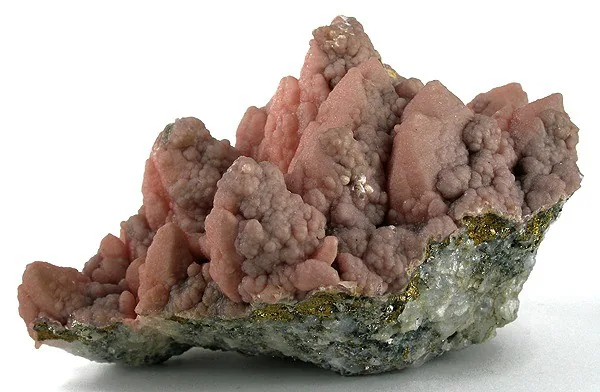
Manganese is a hard, brittle transition metal that never occurs in native form; it is won instead from a family of oxide, carbonate and silicate minerals, chief among them pyrolusite, a manganese dioxide, alongside cryptomelane, romanechite, manganite, braunite and the carbonate rhodochrosite. Its geology is governed by redox: dissolved manganese is mobile in reduced, oxygen-poor water and precipitates as insoluble oxides once it reaches an oxygenated setting.
Read more: the deposit model, why it matters and where it is used +
More on manganese
MineDSS models two of the most productive families through its systems, sedimentary and supergene. Each leaves a mappable footprint of manganese-oxide beds, weathering profiles, characteristic geophysical responses and a co-located multi-element geochemical halo, which is exactly the pattern a prospectivity model is built to read across large, partly covered terrains.
The deposit model
Both systems are governed by low-temperature aqueous chemistry rather than magmatic heat. Sedimentary manganese forms where manganese-bearing basinal or marine water reaches oxygenated, shallow-water conditions and precipitates stratiform beds of manganese oxides and carbonates, typically at basin-margin redox transitions and commonly associated with black shales and banded iron formations. Supergene manganese forms later and at surface, where intense, usually tropical weathering of a manganese-bearing protolith (a sedimentary bed, a manganiferous carbonate or an ultramafic rock) leaches the soluble components and residually concentrates manganese oxides such as pyrolusite, cryptomelane and wad in weathering profiles and gossans; many economic orebodies are supergene-upgraded sedimentary protoliths.
Why it matters
Manganese is indispensable to modern steelmaking, where it has no practical substitute in its main metallurgical role, and it is increasingly drawn into battery supply chains; on that basis it appears on critical- and strategic-minerals lists across several major economies. Demand is anchored by global steel production and reinforced by the buildout of electric-vehicle and grid-storage batteries, in which manganese offers a lower-cost, lower-risk alternative to some scarcer metals. Yet several large consuming economies hold no domestic mine production and are entirely import reliant, and downstream processing is geographically concentrated, so secure and diversified supply is a live concern for both enterprise and government. Transparent, defensible targeting of prospective ground therefore carries real strategic weight.
Where it's used
The dominant use of manganese is in steelmaking, where it acts as a deoxidiser and desulphuriser and as an alloying element delivered mainly as ferromanganese and silicomanganese; it raises strength, hardness, toughness and wear resistance, most dramatically in high-manganese Hadfield steels. Beyond steel, manganese hardens and de-oxidises aluminium and other non-ferrous alloys. In batteries it appears both as manganese dioxide in dry-cell and alkaline cells and, as high-purity manganese sulphate, as a cathode input for lithium-ion chemistries such as nickel-manganese-cobalt and manganese-rich formulations. Further uses span pigments, catalysts, water treatment, fertiliser micronutrients and animal feed.
Questions
Manganese: common questions.
Which manganese deposit types does MineDSS model? +
MineDSS models two deposit systems: sedimentary and supergene manganese. Sedimentary manganese forms as stratiform beds of manganese oxides and carbonates precipitated from basinal or marine water where dissolved manganese reaches oxygenated, shallow-water conditions, often at basin-margin redox transitions and associated with black shales and banded iron formations. Supergene manganese forms at surface, where intense weathering of a manganese-bearing protolith leaches soluble components and residually concentrates manganese oxides such as pyrolusite, cryptomelane and wad. Both are low-temperature, aqueous, redox-driven systems, and that shared footprint is what the model is built to read; it does not attempt to represent unrelated deposit styles.
How is the model tested, and where can I run manganese? +
Every MineDSS model is tested before it is served: we withhold whole blocks of ground, rebuild the model without them, and check that it still ranks the anomalous samples there above background, with test ground kept spatially separate. A model that does not pass our release gates is not used, for any mineral, in any country. National models for manganese run in the United States and Canada, with ranked targets. Manganese is not modelled outside those countries. Skill is model-level, never a specific site's measured accuracy, and never a discovery or JORC / NI 43-101 resource claim.
Which pathfinder elements track manganese? +
The classic pathfinders are iron, barium, cobalt, nickel, zinc and lead, with iron, barium and cobalt leading. Iron shares manganese's redox chemistry and partitions from it across the same oxidation fronts, while barium concentrates in manganese-oxide phases such as romanechite and hollandite. Cobalt, nickel, zinc and lead are strongly adsorbed and scavenged by manganese oxides, so they tend to co-locate with manganese enrichment. These elements are part of the geochemical record our models learn from. In a run on any piece of ground, the map itself is read from geology and rock age, gravity and magnetics, radiometrics, terrain, satellite radar and spectral alteration, so it covers ground that has never been sampled.
Does a high MineDSS score mean a deposit or a resource estimate? +
No. A high score means its evidence closely matches ground where samples assay anomalously high for the target mineral, and it merits closer exploration attention. It is not a discovery, not a JORC or NI 43-101 resource or reserve estimate, and not drilling or investment advice. MineDSS ranks prospectivity to help prioritise where to look; confirming whether manganese is present, and in what grade and tonnage, still requires field programmes, drilling and independent assessment by qualified professionals.
-
Partners
Exploration and mining companies interested in working with us.
-
Investors
The record, the models and the ground they point to.
-
Publishers and researchers
Geological surveys, universities and programmes whose work the record is built on.
MineDSS ranks prospectivity to help you decide where to explore next. It is not a discovery, not a JORC or NI 43-101 resource or reserve estimate, and not drilling or investment advice.