pegmatite / granite
Tantalum prospectivityacross Australia, the USA & worldwide.
Rare-metal pegmatite and granite tantalum, ranked and explained across the United States and Australia.
-
 ✓
✓ Australia
Ranked targets
-
 ✓
✓ United States
Ranked targets
-
 ·
· Canada
Not modelled
- ✓
Everywhere else
Global model
Ranked targets come with national models in Australia and the United States. Everywhere else, the global model returns the prospectivity map, the geology behind it and a confidence read. Next, the models are retrained on the full record and new sources, such as hyperspectral imagery, before we use them to rank and select ground.
How we rank tantalum ground
From a country to a decision.
- 01 · Atlas
Know the ground
The geology, structure, recorded deposits, tenure and geochemistry over the ground, on one map with the source of every layer.
See Atlas - 02 · Open Ground
Find ground you can peg
Which ground is open, held or excluded, read from each licensing authority's own register.
See Open Ground - 03 · Prospectivity
Rank it for tantalum
The ground scored for tantalum, with the evidence behind it and ranked targets in Australia and the United States. Anywhere else, the global model maps tantalum.
See Prospectivity - 04 · Spectral
Map the alteration
The alteration minerals and the structures that control them, from satellite: regional to district scale, and camp scale from WorldView-3.
See Spectral - 05 · Due Diligence
Check before committing
Tenure, land access, environment and the real cost to hold and test a tantalum position.
See Due Diligence -
Talk to us about tantalum
Partners, investors, publishers and researchers.
The deposit system
The tantalum system.
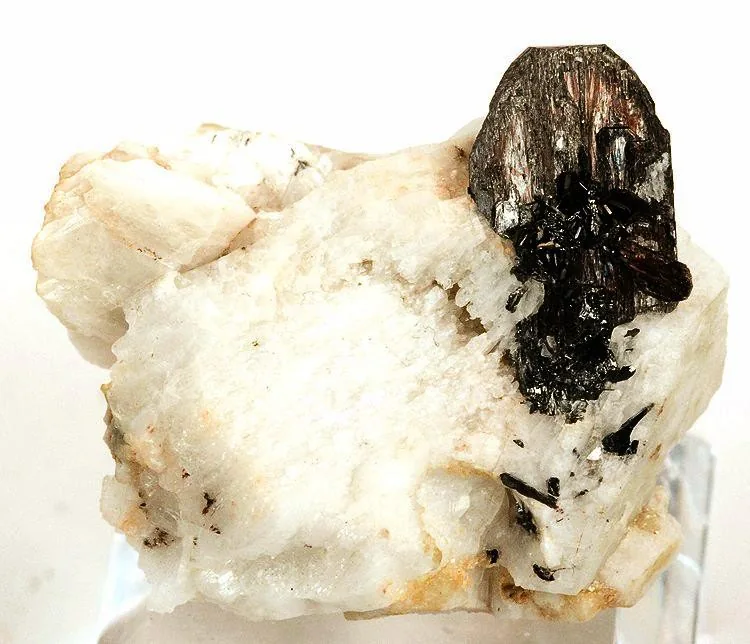
Tantalum is a dense, refractory transition metal and a high-field-strength element prized for its exceptional corrosion resistance and its ability to hold charge in a stable oxide film. In nature it occurs almost entirely in oxide minerals, chiefly the columbite-tantalite series known as coltan, with tantalite the tantalum-rich end member, alongside microlite, wodginite and tapiolite.
Read more: the deposit model, why it matters and where it is used +
More on tantalum
It is won from the most highly evolved granitic melts on Earth. MineDSS models tantalum through two systems: rare-metal pegmatites of the lithium-caesium-tantalum family, and rare-metal granites. Both are the residue of extreme magmatic fractionation, enriched in incompatible elements and marked by albitisation, greisen and a distinctive alkali-metal and tin geochemical halo. Together these form a mappable footprint that a prospectivity model is built to read across large, partly covered terrains.
The deposit model
Both systems are the end products of prolonged fractional crystallisation of peraluminous granitic magma rather than of magmatic heat alone. As a felsic melt cools, incompatible elements (lithium, caesium, rubidium, beryllium, tin, niobium and tantalum, together with the fluxes boron, fluorine and phosphorus) concentrate in the residual liquid, and tantalum is finally fixed as columbite-tantalite and microlite in the most evolved zones. Rare-metal pegmatites form zoned bodies, from border and wall through intermediate to core, with the tantalum oxides and lithium and caesium minerals such as spodumene, lepidolite and pollucite concentrated in the inner zones. Rare-metal granites disseminate the same mineralisation through albitised, greisenised cupolas of highly fractionated granite, commonly alongside cassiterite.
Why it matters
Tantalum is classified as a critical or strategic mineral across several major economies because it is essential to miniaturised, high-reliability electronics and to high-performance alloys used in aerospace and defence, yet its supply is both concentrated and exposed. A large share of mined tantalum originates in central Africa (chiefly the Democratic Republic of the Congo and Rwanda, with further supply from Nigeria and Brazil), and the Congo–Rwanda output in particular falls under conflict-mineral due-diligence regimes alongside tin, tungsten and gold. Demand is reinforced by consumer electronics, the buildout of data-centre infrastructure, and the alloys that harden turbine and defence components. Because production is geographically concentrated and traceability is a live concern, transparent, defensible targeting of prospective ground carries real weight for explorers and the governments that permit them.
Where it's used
The dominant use of tantalum is in tantalum electrolytic capacitors, whose stable, self-healing oxide dielectric packs very high capacitance into a tiny, reliable volume, which is why they are favoured in smartphones, medical devices, automotive electronics and data-centre hardware. Tantalum carbide adds hardness and heat resistance to nickel-based superalloys for jet-engine and turbine components, and to cemented-carbide cutting tools. The metal's outstanding resistance to acids makes it valuable in chemical process equipment, while its biocompatibility supports surgical implants and porous bone-ingrowth prosthetics. Further applications include high-refractive-index optical glass, sputtering targets and specialty electronic components.
Questions
Tantalum: common questions.
Which tantalum deposit types does MineDSS model? +
MineDSS models two deposit systems: rare-metal pegmatites of the lithium-caesium-tantalum family and rare-metal granites. Both are the end products of extreme fractional crystallisation of granitic magma, in which tantalum is concentrated as columbite-tantalite and microlite in the most evolved rock. Pegmatite bodies are typically zoned, with tantalum oxides and lithium and caesium minerals gathered in their inner zones, while rare-metal granites carry disseminated mineralisation through albitised, greisenised cupolas alongside cassiterite. The model does not attempt to represent unrelated deposit styles; it ranks ground by how closely its evidence matches ground where samples assay anomalously high for the target mineral.
How is the model tested, and where can I run tantalum? +
Every MineDSS model is tested before it is served: we withhold whole blocks of ground, rebuild the model without them, and check that it still ranks the anomalous samples there above background, with test ground kept spatially separate. A model that does not pass our release gates is not used, for any mineral, in any country. National models for tantalum run in Australia and the United States, with ranked targets. Anywhere else in the world, the global model returns the prospectivity map, the geology behind it and a confidence read. Skill is model-level, never a specific site's measured accuracy, and never a discovery or JORC / NI 43-101 resource claim.
Which pathfinder elements track tantalum? +
The classic pathfinders are lithium, caesium, rubidium, tin, beryllium and tungsten, with lithium, caesium and rubidium leading for rare-metal pegmatite and granite systems. These are the granophile, incompatible elements that concentrate as a granitic melt fractionates to its most evolved residue: the alkali metals mark the fertile, highly evolved rock, while tin, beryllium and tungsten trace the cassiterite, beryl and greisen associations that travel with tantalum oxides. These elements are part of the geochemical record our models learn from. In a run on any piece of ground, the map itself is read from geology and rock age, gravity and magnetics, radiometrics, terrain, satellite radar and spectral alteration, so it covers ground that has never been sampled.
Does a high MineDSS score mean a deposit or a resource estimate? +
No. A high score means its evidence closely matches ground where samples assay anomalously high for the target mineral, and it merits closer exploration attention. It is not a discovery, not a JORC or NI 43-101 resource or reserve estimate, and not drilling or investment advice. MineDSS ranks prospectivity to help prioritise where to look; confirming whether tantalum is present, and in what quantity and grade, still requires field programmes, drilling and independent assessment by qualified professionals.
-
Partners
Exploration and mining companies interested in working with us.
-
Investors
The record, the models and the ground they point to.
-
Publishers and researchers
Geological surveys, universities and programmes whose work the record is built on.
MineDSS ranks prospectivity to help you decide where to explore next. It is not a discovery, not a JORC or NI 43-101 resource or reserve estimate, and not drilling or investment advice.