granite-related
Tin & tungsten prospectivityacross Australia, the USA & Canada.
Granite-related tin and tungsten, ranked and explained across Australia, the United States and Canada.
-
 ✓
✓ Australia
Ranked targets
-
 ✓
✓ United States
Ranked targets
-
 ✓
✓ Canada
Ranked targets
- ·
Everywhere else
Not modelled
Ranked targets come with national models in Australia, the United States and Canada. Next, the models are retrained on the full record and new sources, such as hyperspectral imagery, before we use them to rank and select ground.
How we rank tin & tungsten ground
From a country to a decision.
- 01 · Atlas
Know the ground
The geology, structure, recorded deposits, tenure and geochemistry over the ground, on one map with the source of every layer.
See Atlas - 02 · Open Ground
Find ground you can peg
Which ground is open, held or excluded, read from each licensing authority's own register.
See Open Ground - 03 · Prospectivity
Rank it for tin & tungsten
The ground scored for tin & tungsten, with the evidence behind it and ranked targets in Australia, the United States and Canada.
See Prospectivity - 04 · Spectral
Map the alteration
The alteration minerals and the structures that control them, from satellite: regional to district scale, and camp scale from WorldView-3.
See Spectral - 05 · Due Diligence
Check before committing
Tenure, land access, environment and the real cost to hold and test a tin & tungsten position.
See Due Diligence -
Talk to us about tin & tungsten
Partners, investors, publishers and researchers.
The deposit system
The tin & tungsten system.
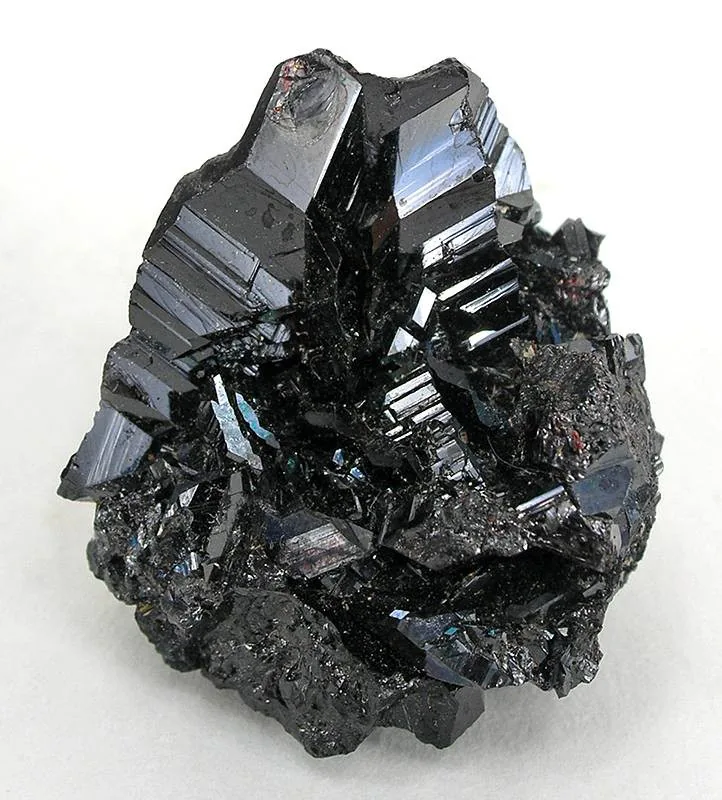
Tin and tungsten are the classic hard-metal pair of the felsic-intrusion world, so closely linked geologically that explorers routinely hunt them together. MineDSS focuses on granite-related tin and tungsten systems: mineralisation sourced from highly evolved, volatile-rich granitic melts.
Read more: the deposit model, why it matters and where it is used +
More on tin & tungsten
As these fractionated granites cool, tin (in cassiterite) and tungsten (in wolframite and scheelite) concentrate in the residual fluids and are deposited in and around the pluton: in greisenised cupolas, sheeted vein and stockwork arrays, quartz-wolframite veins, and reactive skarns where fluids meet carbonate wall rock. These systems carry a distinctive, chemically evolved footprint far larger than the ore itself, and that footprint is what a prospectivity model learns to read.
The deposit model
Granite-related tin and tungsten systems sit in and above the apical zones of evolved, reduced to weakly oxidised felsic intrusions, commonly S-type granites emplaced in deformed metasedimentary terranes. Tin favours greisen (a quartz-mica-topaz-fluorite assemblage produced by fluids altering the granite cupola) plus sheeted cassiterite-bearing veins and stockworks. Tungsten occurs as wolframite in quartz vein swarms and as scheelite in skarns developed where fluids react with carbonate country rock. Greisenisation, tourmalinisation and sericitic alteration mark the system, and the granophile pathfinder association is diagnostic.
Why it matters
Tin and tungsten are strategic industrial metals that both sit on major economies' critical-minerals lists. Tin is fundamental to the electronics that underpin electrification and the digital economy, while tungsten's extreme hardness and heat resistance make it difficult to substitute in tooling, defence and high-performance applications. Supply for both is geographically concentrated and exposed to processing bottlenecks, which keeps Western governments and manufacturers focused on securing new, diversified sources, sustaining exploration interest across established and frontier granite provinces.
Where it's used
Tin's dominant use is solder (the joints binding virtually every printed circuit board and electronic assembly), alongside tinplate, chemicals and specialty alloys. Tungsten's exceptionally high melting point and hardness make it essential in cemented carbides for cutting and mining tools, wear-resistant components, filaments and electrodes, and heavy alloys used in aerospace and defence. Both metals sit at the heart of modern manufacturing supply chains.
Questions
Tin & tungsten: common questions.
Which tin and tungsten deposit types does MineDSS model? +
MineDSS models granite-related tin and tungsten systems: mineralisation sourced from evolved, volatile-rich felsic intrusions. In practice that spans greisen and sheeted-vein tin around granite cupolas, quartz-wolframite vein swarms, and scheelite-bearing skarns where magmatic fluids react with carbonate wall rock.
How is the model tested, and where can I run tin & tungsten? +
Every MineDSS model is tested before it is served: we withhold whole blocks of ground, rebuild the model without them, and check that it still ranks the anomalous samples there above background, with test ground kept spatially separate. A model that does not pass our release gates is not used, for any mineral, in any country. National models for tin & tungsten run in Australia, the United States and Canada, with ranked targets. Tin & tungsten is not modelled outside those countries. Skill is model-level, never a specific site's measured accuracy, and never a discovery or JORC / NI 43-101 resource claim.
Why do lithium, tantalum and niobium matter for tin and tungsten? +
Lithium, rubidium, caesium, tantalum and niobium track how chemically evolved a granite is: the fractionation that governs whether an intrusion is fertile for tin and tungsten. They mark a fertile granite; they are not minerals ranked on this page. These elements are part of the geochemical record our models learn from. In a run on any piece of ground, the map itself is read from geology and rock age, gravity and magnetics, radiometrics, terrain, satellite radar and spectral alteration, so it covers ground that has never been sampled.
Does a high MineDSS score mean there is a deposit? +
No. A high score means its evidence closely matches ground where samples assay anomalously high for tin and tungsten, so it ranks as more prospective and warrants further work. It is a prioritisation of where to look, not a discovery, not a JORC or NI 43-101 resource or reserve estimate, and not drilling or investment advice. Ground truth still requires field verification and drilling.
-
Partners
Exploration and mining companies interested in working with us.
-
Investors
The record, the models and the ground they point to.
-
Publishers and researchers
Geological surveys, universities and programmes whose work the record is built on.
MineDSS ranks prospectivity to help you decide where to explore next. It is not a discovery, not a JORC or NI 43-101 resource or reserve estimate, and not drilling or investment advice.